
|
Macassar Ebony
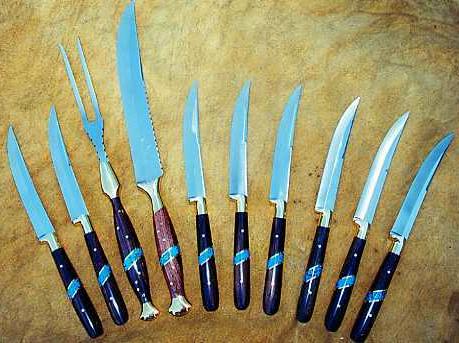
With a heartwood that is dark brown to black interspersed with contrasting bands of yellow to golden brown,
Macassar ebony yields a bold and attractive look by offsetting the darkest of the dark woods with a variety of color. With a heartwood that is dark brown to black interspersed with
contrasting bands of yellow to golden brown, Macassar ebony yields a bold and attractive look by offsetting the darkest of the dark woods with a variety of color.
The trees are native to the Celebes Islands, which are also called the Sulawesi Islands of the East Indies. It is
also found in Maluku and Borneo, known as the Greater Sunda Islands of Indonesia.
Ebony has an interesting history, filled with myths and legends. "Believed to be an antidote to poison," The Encyclopedia of Wood
notes, "ebony was popular with the ancients for use in drinking vessels — such was their perennial agony. The Greek historian Herodotus records that Ethiopia paid an annual tribute of 200 ebony
logs to the Persian Empire. Most supplies came from India and Sri Lanka, so it was not readily available in Europe until the 1600s.
Turquoise is a valuable mineral and is possibly the most valuable, non-transparent mineral in
the jewelry trade. It has been mined for eons since at least 6000 BC. by early Egyptians. Its history also includes beautiful ornamental creations by Native Americans and Persians. Its
popularity is still quite strong today. Although crystals of any size are rare, some small crystals have been found in Virginia and elsewhere. Most specimens are cryptocrystalline, meaning that
the crystals could only be seen by a microscope. The finest turquoise comes from Iran but is challenged by some southwestern United States specimens. Turquoise is often imitated by "fakes", such
as the mineral chrysocolla, and poorer turquoise specimens are often dyed or color stabilized with coatings of various resins. The name comes from a french word which means stone of Turkey, from
where Persian material passed on its way to Europe. |